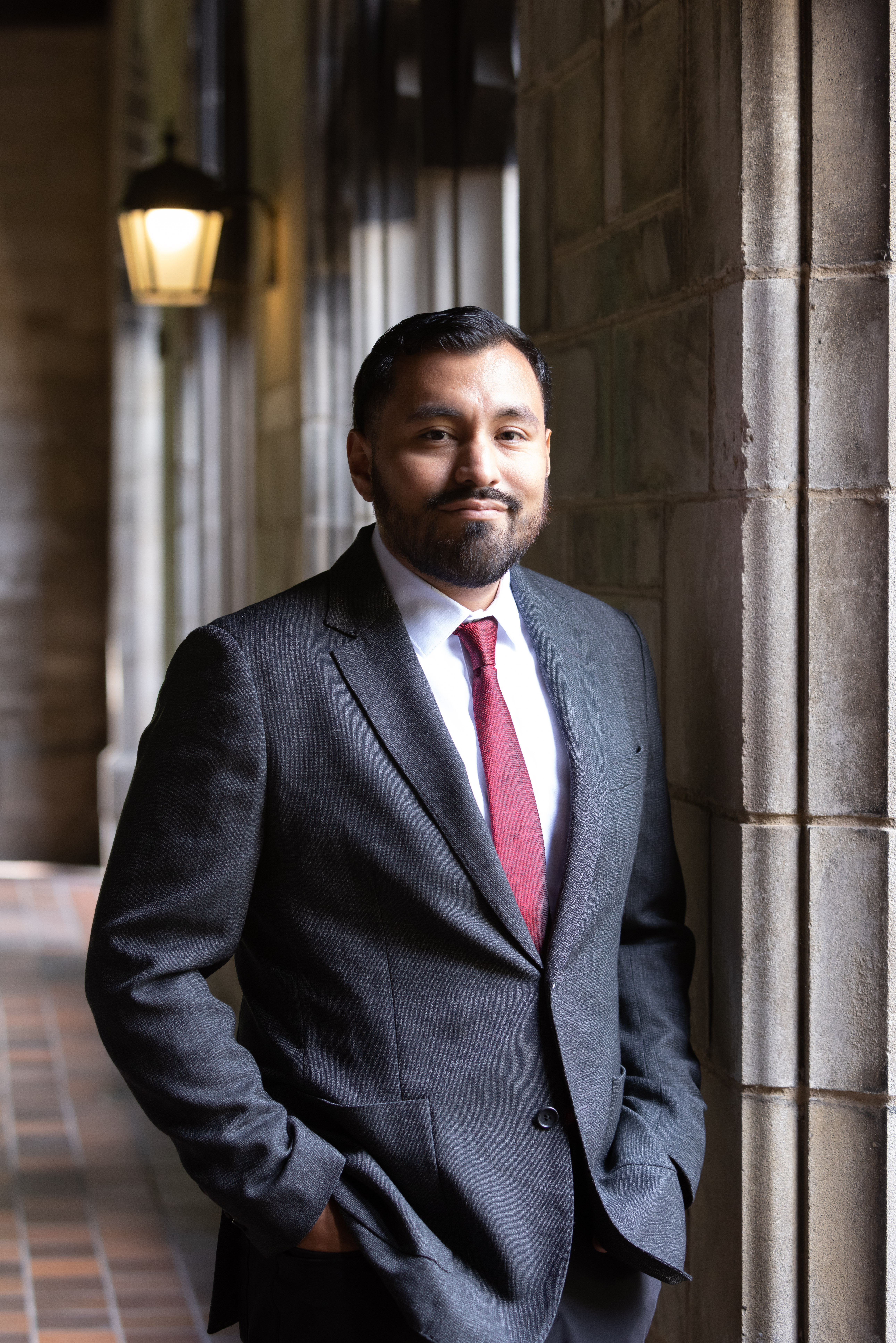
Christopher Campos

5807 South Woodlawn Ave

Chicago, IL 60637

I am an Assistant Professor of Economics and John E. Jeuck Faculty Fellow at the University of Chicago Booth School of Business. I am also a Faculty Research Fellow at the National Bureau of Economic Research (NBER). My research uses a combination of experimental, quasi-experimental, and structural methods to study the economics of education, with an emphasis on how the design of education markets shapes outcomes.

Before pursuing higher education, I served in the United States Marine Corps and served tours in Iraq and Southeast Asia. I received my PhD in Economics from UC Berkeley in 2021 and spent one year as a Postdoctoral Research Associate with the Industrial Relations Section at Princeton University.

Sign up for office hours here.

Email: Christopher.Campos@chicagobooth.edu.

Selected Research

  1. The Impact of Public School Choice: Evidence from Los Angeles’ Zones of Choice
    Campos, Christopher, and Kearns, Caitlin
    Quarterly Journal of Economics 139(2), 2024
    Does a school district that expands school choice provide better outcomes for students than a neighborhood-based assignment system? This paper studies the Zones of Choice (ZOC) program, a school choice initiative of the Los Angeles Unified School District (LAUSD) that created small high school markets in some neighborhoods but left attendance-zone boundaries in place throughout the rest of the district. We study market-level impacts of choice on student achievement and college enrollment using a differences-in-differences design. Student outcomes in ZOC markets increased markedly, narrowing achievement and college enrollment gaps between ZOC neighborhoods and the rest of the district. The effects of ZOC are larger for schools exposed to more competition, supporting the notion that competition is a key channel. Demand estimates suggest families place substantial weight on schools’ academic quality, providing schools with competition-induced incentives to improve their effectiveness. The evidence demonstrates that public school choice programs have the potential to improve school quality and reduce neighborhood-based disparities in educational opportunity.
    The Impact of Public School Choice: Evidence from Los Angeles’ Zones of Choice
  2. Who Benefits from Remote Schooling? Self-selection and Match Effects
    Bruhn, Jesse, Campos, Christopher, Chyn, Eric, and Tran, Anh
    Revise and Resubmit at the American Economic Review
    We study the distributional effects of remote learning using a novel approach that combines preference data from a conjoint survey experiment with administrative student records. The experimentally derived preference data allow us to account for selection into remote learning while also studying selection patterns and treatment effect heterogeneity. We validate the approach using random variation from school choice lotteries. Our analysis of the average impacts of remote learning finds negative effects on reading (-0.13 SD) and math (-0.14 SD) achievement. Notably, we find evidence of positive learning effects for children whose parents have the strongest demand for remote learning. Parental concerns related to bullying appear to be an important driver of the demand for remote learning. Moreover, we find that across-the-board positive impacts of remote learning on bullying outcomes operate as a compensating differential for negative impacts on learning. Our results suggest that an important subset of students who currently sort into post-pandemic remote learning benefit from expanded choice.
    Who Benefits from Remote Schooling? Self-selection and Match Effects
  3. Who Chooses and Who Benefits? The Design of Public School Choice Systems
    Campos, Christopher, Chyn, Eric, Bruhn, Jesse, and Vazquez, Antonia
    Under Review
    Public school choice has evolved rapidly in the past two decades, as districts roll out new magnet, dual-language, and themed programs to broaden educational opportunity. We use newly collected national data to document that opt-in (voluntary) systems: (i) are the modal design; (ii) are harder to navigate; and (iii) have participation that is concentrated among more advantaged students. These facts suggest a striking inconsistency: districts have largely adopted centralized assignment algorithms to broaden access, but most rely on optional participation that fragments public education. We study the implications of this design choice in the Los Angeles Unified School District, the largest opt-in system in the country, combining two decades of administrative data, randomized lotteries, and quasi-experimental expansions in access. Participation is highly selective, consistent with national evidence, and lottery estimates suggest that the students with the lowest demand for choice schools are the ones who gain the most from attending. Opt-in participation therefore embeds a selection mechanism that screens out high-return students and leaves many effective programs with unused capacity. To evaluate system-level implications, we estimate a structural model linking applications, enrollment, and achievement. Choice schools are vertically differentiated and generate meaningful gains, but the opt-in participation rule—through high application costs and negative selection on gains—prevents these benefits from reaching the students who need them most. Counterfactual simulations make the design stakes clear: information and travel-cost reductions have limited effects, whereas reforms that change the participation architecture eliminate core inefficiencies and deliver the largest district-wide achievement gains. These results underscore that system design—not school effectiveness alone—shapes who benefits from public school choice and to what extent.
    Who Chooses and Who Benefits? The Design of Public School Choice Systems